

Vision – A land of Abundance, Opportunity, Spirituality and Technology with Happy Citizens
15 August 2026 | Dr Rajendra Pratap Gupta
The arithmetic of a dream
Today is our 80th Independence Day. After today, we have twenty-one more Independence Days before 2047.
Twenty-one. That is fewer than the number of years it took India to move its research spending from 0.7% of GDP to… 0.7% of GDP.
I have said for years that short-term solutions of today become the long-term problems of tomorrow. The Viksit Bharat Abhiyan was built on that single insight: we borrowed our planning from Russia, our bureaucracy from Britain, and our aspirations from America , and never built an Indian model of development of our own. We focused on the top floor without laying a foundation.
But something has changed since we published that primer. The window has not just narrowed. It has been compressed by Artificial Intelligence.
The view from 2030
When I mapped the Functional AI Pyramid — the AI Maturity Model, I placed seven levels on it: two pre-AI levels (Naïves and Watchers) and five AI levels — Talkers, Thinkers, Doers, Creators and Leaders. What matters for today’s speech-making and flag-hoisting is a single, uncomfortable fact about where we are standing on that pyramid right now.
- Level 1 — Talkers (AI that talks): 2015–2024. Done. Behind us.
- Level 2 — Thinkers (AI that thinks): 2023–2025. Behind us.
- Level 3 — Doers (AI that acts): 2025–2027. We are living in it today.
- Level 4 — Creators (AI that creates): 2027–2029. One general election away.
- Level 5 — Leaders (AI that runs systems): 2029–2030. Within this decade.
Read that again. The entire transformation that we assumed would take a generation will be substantially complete before the first quarter of this century’s second half begins. Medicine has historically taken seventeen years to adopt a proven discovery. AI will not wait seventeen years. It is compressing decades into months.
So here is the view of the future I want every Indian to hold in their mind today:
Firstly, every Indian must introspect as a generation. At least, the pre-Gen Z generation has messed up. We have left a world in crisis, economically, environmentally and in every manner we can think of. We have just considered GDP as a measure of our progress, which is so wrong. We need to go back to the drawing board and the Viksit Bharat original document put up the ten building blocks and that is the starting point.
By 2030, every profession will have been repriced. AI first augments, and then replaces what it augments. That is not a prophecy; it is the observable pattern of the last three years. We have to move to a model where we create distributed growth – http://www.projectcreate.tech was one of such initiatives but we need more in terms of rur-ban models creating jobs for every hand.
We must also address the BIG question hiding inside all of this: when the cognitive work of the world becomes abundant and cheap, what exactly is our demographic dividend worth?
We have been selling the world a story about 1.4 billion young people. AI has just changed the price of that story. A demographic opportunity that is not converted into a cognitive and creative opportunity is not a dividend. It is a liability with a birth certificate.
Why the ten building blocks matter more now, not less
Some will read the above and conclude that India needs an AI plan. That is exactly the mistake we made in 1951, and then wondered why the foundation cracked.
Economy is an outcome. It can never be a goal. The same is true of technology.
| Building block | What AI changes by 2030 |
|---|---|
| Vision | Forecasting and back-casting become computable. We can finally plan for 25, 50 and 100 years, and audit ourselves annually against it. |
| Culture & Heritage | 500,000 heritage sites, 22 official languages, the world’s largest diaspora, AI translation and immersive media make India’s soft power scalable for the first time. |
| Citizens | The changemaker no longer needs an election or an exam. Inquiry and action are now available to anyone with a phone. |
| Psychology | The hardest block. Systems are easy to change; mindsets are not. Ceremonial to functional. Symbolism to substance. Problem-centric to opportunity-centric. |
| Governance | No citizen in the 21st century should visit a government office for an approval. Proactive, system-driven, technology-backed governance is now technically trivial and politically hard. |
| Environment | AI-optimised grids, water, agriculture and logistics, or sustainable AI consumption |
| Policies, Processes, Systems | Legacy systems must go in five to seven years, not twenty-five. Bureaucracy remains the single biggest bottleneck to India’s potential. |
| Institutions | Institutions must be futuristic, agile, accountable, and driven by data, science and evidence. not by precedent files. |
| Infrastructure | For 1.61 billion people by 2047, intelligence becomes infrastructure. Compute, data and connectivity are the new roads and railways. But Agriculture and retail will be equally important for a distributed growth model. |
| Economy | The outcome of the nine above. A $37 trillion economy at 10.5% growth; $73 trillion at 13.5%. AI, when deployed rationally can help us as a lower-middle-income country |
And one non-negotiable principle underneath all of it: We must inculcate ethics and rationale along with a culture of data. The ethical failures of systems are rooted in ethics , governance , the data they are trained on, far more than in the algorithms. A nation that gets its data governance wrong will simply automate its existing inequalities at machine speed. We cannot afford a digital divide in the AI era.
The audit before the action
Before any action plan, one honest question. Where are you on the pyramid today?
- Naïve — You have not seriously used an AI system this month. You are at the highest risk: irrelevance before you are even aware the transformation happened.
- Watcher — You have used it, you are unimpressed, you think it is a decade away. Awareness without action is its own form of risk.
- Talker — You use it to write, translate, summarise, respond.
- Thinker — You use it to reason, compare options, and make better decisions.
- Doer — You have deployed it to act: workflows that run without you.
- Creator — You are making things that did not exist before.
- Leader — You are redesigning an institution around it.
Most of India’s professional class, including many at the very top, is sitting at Naïve or Watcher while the world moves through Doer. That gap is the whole ballgame.
The action plan: Every Day, Every Week, Every Month, Every Year
Viksit Bharat Abhiyan was always a call of conscience for a call to action. Speeches do not build nations; calendars do. Here is what I believe every Indian — student, farmer, clinician, coder, clerk, CEO ,can commit to from today.
Every day (30–45 minutes)
- Start small and be consistent in what you decide to do
- Make a positive difference : Make someone smile every day- if you do to a stranger, much better.
- Make once change : Eliminate one step. One redundant form, one unnecessary approval, one wasteful process at your desk or in your home. Elimination is the cheapest reform available to a citizen.
- Learn a new skill; Write, read or teach in it. Our identity, our fundamental research and our education were all compromised by a rote learning model
- Do one act of inquiry. Ask one question about something in your surroundings that affects your life — your ward, your school, your hospital, your water. Change begins with inquiry and action, not with position.
- Move your body and log it. Poor stand on their feet, and the old walk on their feet. Health is an enabler of development, not a consequence of it.
Every week
- Teach one person what you learned. A parent, a peon, a peer, a student. India will not be lifted by 100 experts; it will be lifted by 100 million competent people.
- Give one hour to a public institution. A government school, a PHC, an RWA, a panchayat, a municipal ward. Duties were added to our Constitution twenty-six years after rights. We have been catching up ever since.
- Automate one recurring task at work. Move yourself one rung up the pyramid, Talker to Thinker, Thinker to Doer.
- Read one primary source, not one headline. A budget line, a policy draft, a judgment, a dataset. Opinions are abundant; evidence is scarce.
- Buy from one MSME or artisan. We created a few billion-dollar companies and ignored the enterprises that employ India.
Every month
- Mentor one young person on what they should build, not on which exam they should clear.
- Spend on culture once. A heritage site, a local art form, a craft, a regional book or film. Thirty-seven per cent of global tourism is culturally motivated, and cultural industries create the most jobs for the 15–29 age group. We should be the culture capital of the world; we are sixth on the list with forty sites.
- Run a family review — health screening, finances, and one conversation about why staying and building here is worth it. Six lakh Indians renounced citizenship in five years. Every family retained is a small act of nation-building.
- Check your surrounding and if something needs to be changed, take a step for change
Every year
- Move up exactly one level of the Functional AI Pyramid. Write down where you are today, and where you will be next 15 August.
- Shape one thing that outlives the year
- Take one national-interest project beyond your job description — public health, education, environment, MSME, language, or governance.
- Reduce your ecological footprint measurably and get one institution around you to do the same.
- Publish your own scorecard. What did you build, whom did you lift, what did you eliminate? Personal excellence aligned with national interest — that is the only nationalism that compounds.
Remember- our forefathers fought to get political freedom, and we have to fight for Economic Freedom, and move ahead for a broader goal to create a Developed India
In 1947 we won freedom from a foreign power. In 2047 we must win freedom from being a lower-middle-income country. That is our second freedom struggle, and unlike the first, it will not be fought in jails and on salt marches. It will be fought in classrooms, laboratories, clinics, workshops, ward offices and on 1.4 billion screens — one day at a time.
Sardar Patel dreamed of an India where no one dies of starvation, where justice is neither costly nor difficult, and where the best-paid official does not earn a great deal more than the lowest-paid servant. That dream is still unfinished. AI does not finish it for us. AI only decides how fast we find out whether we meant it.
If India is to become Aatmanirbhar, every Indian must first become dependent on their own Aatma. अगर भारत को आत्मनिर्भर बनाना है तो हर एक भारतीय को अपनी आत्मा पर निर्भर होना पड़ेगा।
That is why I say it again on this 80th Independence Day: Viksit Bharat Abhiyan is a call of conscience for a call to action.
Twenty-one Independence Days. Start today.
🇮🇳 स्वतंत्रता दिवस की हार्दिक शुभकामनाएँ!
आज हम उन वीरों को नमन करते हैं जिन्होंने हमें राजनीतिक स्वतंत्रता दिलाई। अब हमारी पीढ़ी का राष्ट्रीय दायित्व है-भारत को गरीबी, असमानता, अशिक्षा, बीमारी और बेरोज़गारी से मुक्त कर वर्ष 2047 तक एक समृद्ध, आत्मनिर्भर और विकसित राष्ट्र बनाना।
विकसित भारत का निर्माण केवल सरकार का लक्ष्य नहीं, बल्कि प्रत्येक भारतीय का संकल्प है। आइए, इस स्वतंत्रता दिवस पर हम अपने कर्तव्य, कौशल, नवाचार और सामूहिक प्रयासों से राष्ट्र निर्माण में योगदान देने की प्रतिज्ञा लें।
आज़ादी हमें विरासत में मिली है; विकसित भारत हमें विरासत में देना है।
जय हिन्द! जय भारत! 🇮🇳
viksitbharat.org
Dr Rajendra Pratap Gupta is the Founder of Viksit Bharat Abhiyan (Developed India Mission) and the creator of the Functional AI Pyramid — AI Maturity Model. He is the author of Your Vote Is Not Enough, Tough Choices & Hard Decisions: Rebuilding India — the Next 25 Years, and Digital Health: Truly Transformational.
www.viksitbharat.org · www.developedindiamission.org · www.digitalhealth.ac.in




 . Much indebted for this favour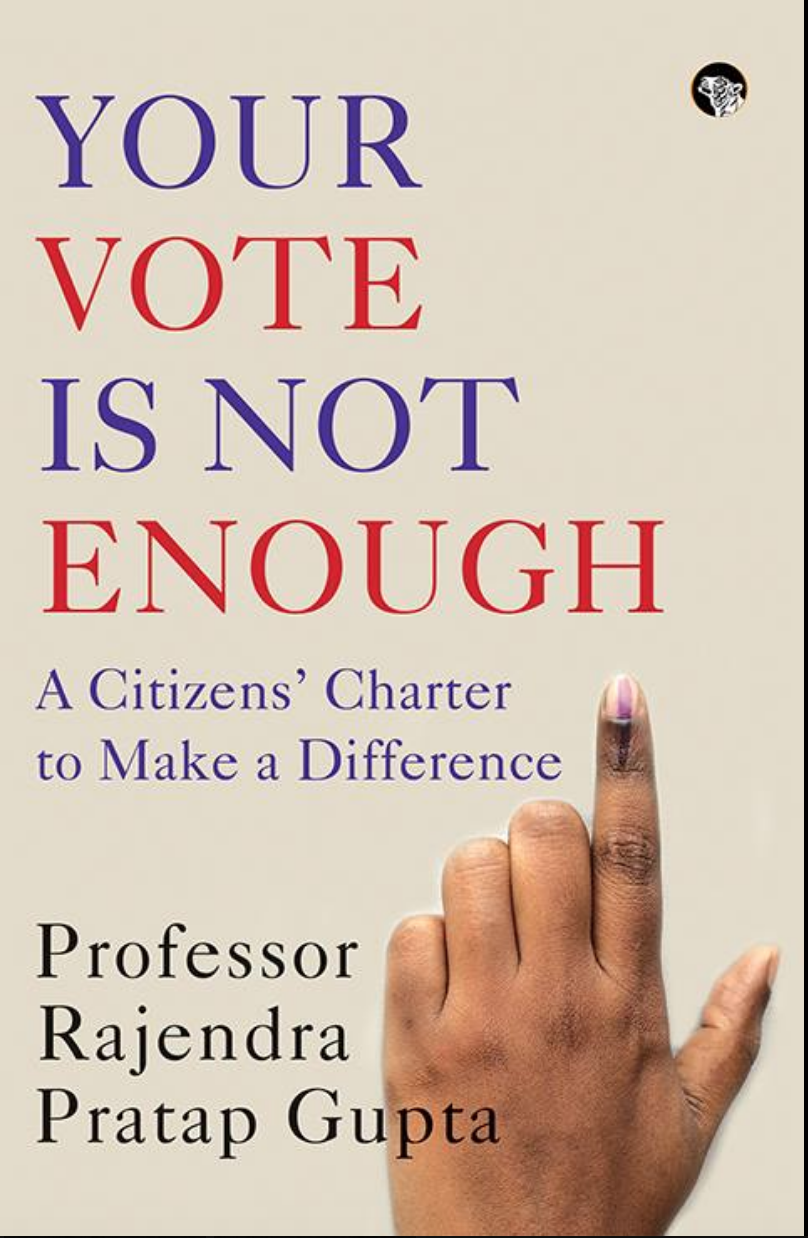
 A Common Man's View Point (Blog)